Custom Web Development Costs: 2025 Breakdown
Comprehensive guide to custom web development costs in 2025. Detailed pricing breakdown by project type, region, and complexity. Real data from 200+ projects to help you budget accurately.
Custom Web Development Cost Breakdown 2025: Real Pricing Data & What to Expect
“How much does custom web development cost?”
It’s the first question every business owner asks—and the hardest to answer directly. The truthful answer is: it depends. But that’s not helpful when you’re trying to budget.
This guide provides real pricing data based on 200+ projects we’ve analyzed, giving you concrete numbers and the factors that influence them. By the end, you’ll understand exactly what drives costs and how to budget accurately for your project.
The Problem: Opaque Pricing Hurts Everyone
Why Web Development Pricing Is Confusing
The web development industry has a pricing problem. Get quotes from five agencies, and you might receive prices ranging from $5,000 to $150,000 for seemingly the same project. This confusion exists because:
- No standardized scope definitions: One agency’s “website” is another’s “web application”
- Hidden complexity: Simple-sounding features can be engineering nightmares
- Regional price variations: Developer rates vary 10x between regions
- Quality differences: Junior vs. senior developers produce different results
- Overhead structures: Agencies have different cost structures
The Cost of Getting It Wrong
Underbidding leads to:
- Project abandonment mid-development
- Cut corners and technical debt
- Broken relationships with vendors
Overbidding leads to:
- Unnecessary budget drain
- Opportunity cost of unused capital
- Executive distrust of future projects
This guide aims to give you the knowledge to budget accurately and evaluate quotes confidently.
The Solution: Data-Driven Cost Understanding
We’ve analyzed pricing data from our own projects and industry benchmarks to create this comprehensive breakdown.
Website Types and Typical Costs
| Project Type | Price Range (2025) | Typical Timeline | Examples |
|---|---|---|---|
| Basic Website | $3,000 - $10,000 | 2-4 weeks | Portfolio, Landing page, Small business site |
| Business Website | $10,000 - $30,000 | 4-8 weeks | Corporate site, Multi-page site with CMS |
| E-commerce Store | $15,000 - $75,000 | 6-16 weeks | Online store, Marketplace basics |
| Web Application | $30,000 - $150,000 | 8-24 weeks | SaaS platform, Dashboard, Custom tool |
| Enterprise Platform | $100,000 - $500,000+ | 6-18 months | Complex integrations, Multiple user types |
Let’s break down what you get at each level.
Detailed Cost Breakdown by Project Type
1. Basic Website ($3,000 - $10,000)
What’s included:
- 1-5 pages (Home, About, Services, Contact)
- Responsive design (mobile-friendly)
- Contact form with email notifications
- Basic SEO setup
- SSL certificate
- CMS for content updates (optional)
- 1-2 rounds of revisions
Cost breakdown:
Design                   $800 - $2,500
Development            $1,500 - $5,000
Content setup            $300 - $1,000
Testing & launch         $400 - $1,500
------------------------
Total                  $3,000 - $10,000
Who this is for:
- Freelancers needing an online presence
- Small businesses with limited budgets
- Personal portfolios
- Landing pages for campaigns
Example: A local restaurant wanted an online presence with menu, location, and reservation link. We delivered a 4-page responsive site with CMS in 3 weeks for $4,500.
2. Business Website ($10,000 - $30,000)
What’s included:
- 10-25 pages
- Custom design (not templates)
- Advanced CMS configuration
- Blog/news section
- Multiple contact forms
- Newsletter integration
- SEO optimization
- Analytics setup
- Performance optimization
- 3-4 rounds of revisions
Cost breakdown:
Strategy & planning      $1,000 - $2,500
Design (UI/UX)          $3,000 - $8,000
Development             $4,000 - $12,000
Content migration        $500 - $2,000
Testing & QA            $1,000 - $3,000
Launch & training         $500 - $2,500
------------------------
Total                 $10,000 - $30,000
Who this is for:
- Growing businesses
- Professional services firms
- Companies with multiple service lines
- Organizations needing content marketing
Example: A law firm needed a professional site showcasing 15 practice areas, attorney profiles, case studies, and a blog. We delivered a custom-designed site with full CMS in 7 weeks for $22,000.
3. E-commerce Store ($15,000 - $75,000)
What’s included:
- Product catalog (varies by size)
- Shopping cart and checkout
- Payment gateway integration
- Inventory management
- Order management system
- Customer accounts
- Email notifications
- Shipping calculation
- Tax handling
- Mobile-optimized shopping experience
Cost breakdown:
Strategy & planning       $2,000 - $5,000
Design (UI/UX)           $4,000 - $15,000
Development             $6,000 - $35,000
Payment integration      $1,000 - $5,000
Testing & QA            $1,500 - $8,000
Launch & training         $500 - $7,000
------------------------
Total                  $15,000 - $75,000
What affects e-commerce pricing:
| Factor | Low End | High End |
|---|---|---|
| Product count | < 50 products | 10,000+ products |
| Customization | Standard Shopify theme | Fully custom design |
| Payment methods | Single gateway | Multi-currency, BNPL |
| Integrations | Basic | ERP, POS, CRM, 3PL |
| Features | Standard checkout | Subscriptions, B2B |
Example: A fashion brand needed an online store with 500 products, Shopify Plus, custom theme, and Klaviyo integration. We delivered a high-converting store in 12 weeks for $48,000.
4. Web Application ($30,000 - $150,000)
What’s included:
- User authentication and authorization
- Database design and implementation
- Custom business logic
- API development
- Admin dashboard
- User roles and permissions
- Data visualization
- Reporting features
- Third-party integrations
- Security implementation
Cost breakdown:
Discovery & planning      $3,000 - $12,000
Architecture design       $2,000 - $8,000
UI/UX design            $5,000 - $25,000
Frontend development    $8,000 - $35,000
Backend development    $10,000 - $50,000
Testing & QA            $2,000 - $15,000
DevOps & deployment       $500 - $5,000
------------------------
Total                  $30,000 - $150,000
Complexity factors:
| Factor | Impact on Cost |
|---|---|
| User types | +$5-15K per additional role |
| Real-time features | +$10-30K |
| Third-party integrations | +$2-10K each |
| Advanced security | +$5-20K |
| Mobile apps | +$20-50K |
| AI/ML features | +$15-50K |
Example: A logistics company needed a custom fleet management application with driver apps, real-time tracking, route optimization, and client portal. We delivered an MVP in 16 weeks for $95,000, with ongoing development for additional features.
5. Enterprise Platform ($100,000 - $500,000+)
What’s included:
- Complex multi-tenant architecture
- Advanced security and compliance
- Multiple integrated systems
- Custom workflows and automation
- Enterprise integrations (SAP, Salesforce, etc.)
- High availability and scalability
- Comprehensive documentation
- Training and change management
- Ongoing support and maintenance
Cost breakdown:
Discovery & strategy       $10,000 - $50,000
Architecture & planning   $15,000 - $40,000
Design system             $20,000 - $60,000
Development              $50,000 - $250,000+
Integrations             $15,000 - $75,000
Testing & QA             $10,000 - $50,000
Deployment & DevOps       $5,000 - $25,000
Training & documentation   $5,000 - $20,000
------------------------
Total $100,000 - $500,000+Example: A healthcare organization needed a patient management platform integrated with existing EHR systems, compliant with HIPAA, supporting 50+ clinics. The project spanned 14 months with a budget of $340,000.
The Stack: How Technology Choices Affect Cost
Technology decisions impact both initial development cost and long-term maintenance.
Frontend Technologies
| Technology | Cost Impact | Best For |
|---|---|---|
| WordPress | Lower initial | Content sites, blogs |
| Shopify | Medium | E-commerce |
| React/Next.js | Higher initial, lower maintenance | Web applications |
| Astro | Medium | Marketing sites, high performance |
| Custom vanilla | Varies | Simple sites only |
Backend Technologies
| Technology | Cost Impact | Best For |
|---|---|---|
| Node.js | Standard | APIs, real-time apps |
| Python/Django | Standard | Data-heavy apps, ML |
| PHP/Laravel | Lower | CMS-based sites |
| .NET | Higher | Enterprise, Windows environments |
| Serverless | Lower hosting, higher development | Variable workloads |
Database Choices
| Technology | Cost Impact | Best For |
|---|---|---|
| PostgreSQL | Standard, free | Most applications |
| MySQL | Standard, free | Traditional apps |
| MongoDB | Standard | Document-heavy apps |
| Firebase | Lower initial | MVPs, real-time |
| Enterprise DBs | Higher | Compliance, enterprise |
Regional Pricing: Where You Hire Matters
Developer rates vary dramatically by region:
| Region | Hourly Rate Range | Notes |
|---|---|---|
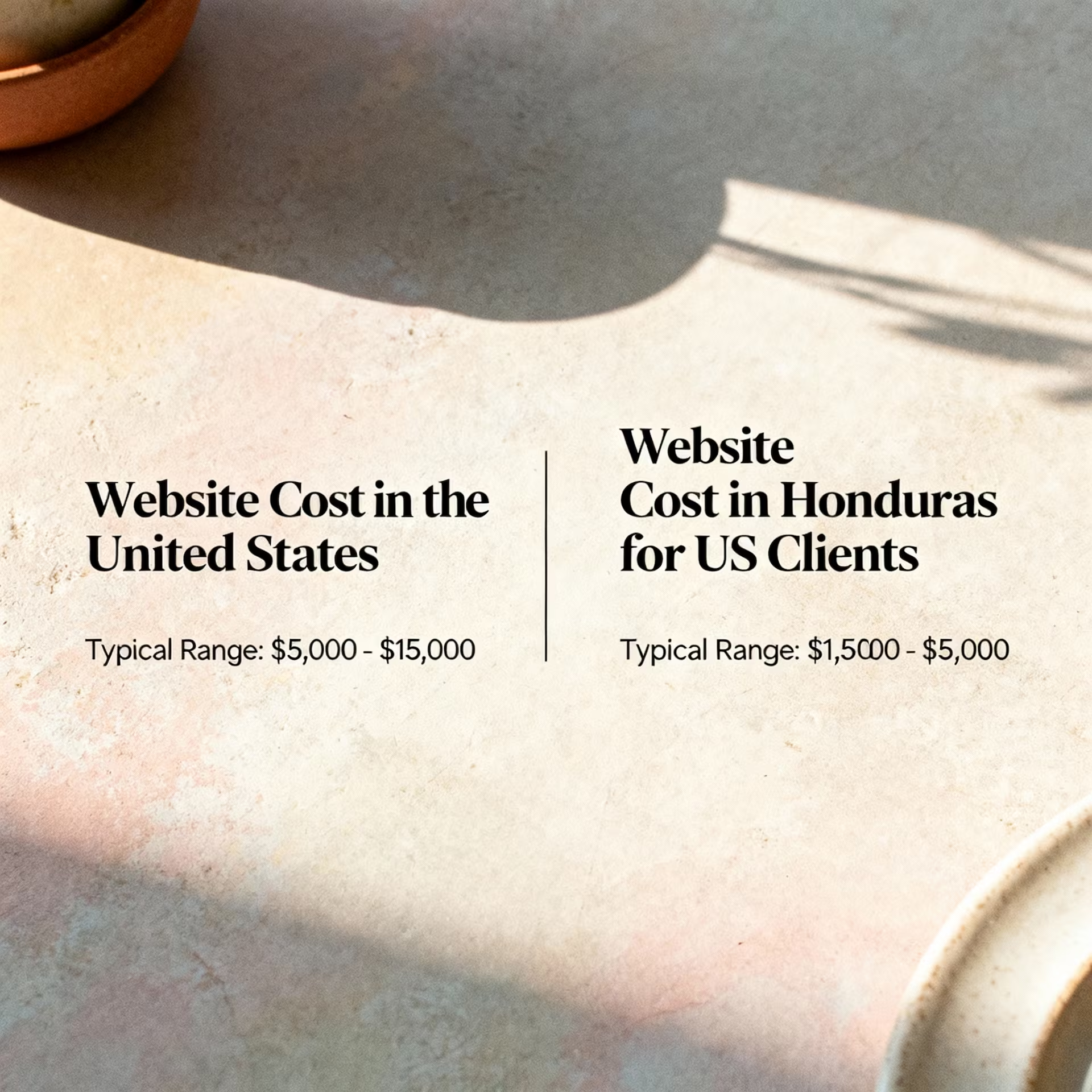
| United States | $150 - $300/hr | Highest quality, highest cost |
| Western Europe | $100 - $200/hr | Strong quality, GDPR expertise |
| Eastern Europe | $50 - $100/hr | Strong technical skills |
| Latin America (Nearshore) | $45 - $95/hr | US timezone, English fluent |
| South Asia | $20 - $50/hr | Lower cost, timezone challenges |
| Southeast Asia | $25 - $60/hr | Growing talent pool |
The Hidden Costs of “Cheap” Development
While offshore rates look attractive, consider:
Communication overhead: 12-hour timezone differences mean 24-hour feedback loops. A simple question becomes a 2-day delay.
Quality variance: Lower rates often mean junior developers. You might pay less per hour but need more hours.
Rework costs: We frequently rescue projects from cheap offshore development. Typical rescue costs: $20,000-$50,000—often more than doing it right initially.
Management burden: You’ll spend more time managing remote teams, reviewing code, and fixing issues.
The Nearshore Advantage
Nearshore development (Latin America for US companies) offers a middle ground:
- 60% cost savings vs. US agencies
- Same timezone for real-time collaboration
- English fluency for clear communication
- Cultural alignment with US business practices
- Senior talent with US company experience
This is why we operate from Central Time with English-fluent senior engineers. Clients get US-quality work at significantly lower costs without the offshore headaches.
How to Budget for Your Project
Step 1: Define Your Project Type
Use the categories above to identify where your project fits. Be honest about complexity—most people underestimate.
Step 2: List Your Features
Create a feature list with priorities:
| Priority | Feature | Estimated Impact |
|---|---|---|
| Must have | Core functionality | Base cost |
| Should have | Important but not critical | +15-25% |
| Nice to have | Future enhancements | Phase 2 |
Step 3: Add Contingency
Always add contingency for unknowns:
| Project Complexity | Contingency Buffer |
|---|---|
| Simple/familiar | 10-15% |
| Medium complexity | 15-25% |
| Complex/novel | 25-40% |
Step 4: Consider Ongoing Costs
Your website isn’t a one-time expense:
| Ongoing Cost | Monthly Range |
|---|---|
| Hosting | $20 - $500+ |
| Domain | $15/year |
| SSL | Free - $200/year |
| Maintenance | $100 - $2,000 |
| Updates/changes | $500 - $5,000 |
| Security monitoring | $50 - $300 |
Red Flags in Web Development Quotes
Watch for these warning signs when evaluating proposals:
Too Low
- Quote significantly below market: They’re either inexperienced, plan to cut corners, or will request more money later
- No questions about your business: Good developers need to understand context
- Vague timeline: “4-6 weeks or so” suggests they haven’t thought it through
Too High
- Enterprise processes for simple sites: You don’t need a $50K “discovery phase” for a 5-page site
- Excessive padding: Every line item seems inflated
- Unnecessary technology: Recommending complex tech stack for simple needs
Just Right
- Detailed scope breakdown: Line items that explain what’s included
- Questions about your goals: Focus on business outcomes, not just technical specs
- Clear timeline with milestones: Specific deliverables at specific points
- Transparent communication: Explains trade-offs between options
How to Get Accurate Quotes
Prepare Your Request
Provide potential vendors with:
- Business context: What does your company do? Who are your customers?
- Project goals: What problem are you solving? What outcomes matter?
- Feature list: What functionality do you need?
- Design preferences: Examples of sites you like
- Technical constraints: Required integrations, platforms, compliance
- Timeline: When do you need to launch?
- Budget range: Sharing a range helps vendors propose appropriately
Compare Apples to Apples
Ask each vendor:
- What’s included in the price?
- What’s explicitly excluded?
- What assumptions are you making?
- What could cause the price to increase?
- What’s the payment schedule?
- What happens if we need changes?
Real Project Examples and Costs
Project 1: Professional Services Website
Client: Accounting firm with 3 partners Need: Modern website with blog, service pages, team bios, contact form Scope: 12 pages, custom design, CMS integration
Cost breakdown:
Design (custom)          $4,000
Development              $8,500
Content migration          $800
SEO setup                $1,200
Training                   $500
------------------------
Total $15,000Timeline: 5 weeks
Project 2: E-commerce Store
Client: Home goods brand selling direct-to-consumer Need: Shopify store with custom theme, 200 products, Klaviyo integration Scope: Custom design, advanced filtering, email automation
Cost breakdown:
Strategy & planning       $2,500
Design (custom theme)    $12,000
Development             $18,000
Integrations             $5,000
QA & testing             $3,500
Launch & training        $2,000
------------------------
Total $43,000Timeline: 10 weeks
Project 3: SaaS MVP
Client: Startup with pre-seed funding Need: Project management tool MVP with team features Scope: User auth, projects, tasks, team management, basic reporting
Cost breakdown:
Discovery                $3,000
Architecture             $2,500
UI/UX design            $8,000
Frontend (React)        $15,000
Backend (Node.js)       $18,000
Testing                  $4,000
Deployment               $1,500
------------------------
Total $52,000Timeline: 12 weeks
Key Takeaways
What We’ve Learned From 200+ Projects
-
Budget realistically: Most projects cost more than clients initially expect. This isn’t vendors being greedy—it’s complexity being underestimated.
-
Invest in planning: Spending $3,000-$5,000 on proper discovery and planning can save $20,000+ in development by avoiding wrong directions.
-
Consider total cost of ownership: A $20,000 site that needs constant fixes costs more than a $35,000 site built correctly.
-
Match vendor to project: Don’t hire an enterprise agency for a small business site, and don’t hire a freelancer for a complex platform.
-
Nearshore offers the best value: For US companies, Latin American development provides US-quality work at 40-60% lower cost without offshore headaches.
Get a Custom Quote for Your Project
At Codebrand, we provide detailed, transparent quotes based on your specific needs. Our quotes include:
- Line-item cost breakdown
- Clear scope definition
- Realistic timeline with milestones
- Assumptions and exclusions documented
- Fixed-price options where appropriate
Ready to discuss your project? Get a free consultation and detailed quote. We’ll help you understand your options and budget accurately.
Do you want to read more articles?
Visit our blog to explore more content on web development, design, and digital marketing.